CoverageMap API
Determine the best carrier based on a list of locations, and get detailed coverage, signal strength, and speed test analysis. Try today, no credit card required.
- One batch REST endpoint
- AT&T, Verizon and T-Mobile, LTE and 5G
- Coordinates and address lookups
- Free trial, no credit card
What is the CoverageMap API?
The CoverageMap API is a REST API that reports how good cellular service is at any location in the United States. Send latitude/longitude coordinates, or street addresses, and get back what the coverage and performance looks like in the given area.
Every response is scoped to the carriers and technologies you ask for. Pick AT&T, Verizon or T-Mobile, choose LTE, 5G or both, and select the datasets you want with a single field in the request body.
The API supports batch requests, so you can send a list of locations and get a single response with all the data you need. All with simple billing by the location and dataset. Setup is easy and can be done in minutes.
What are the Datasets?
3 datasets are available today. Coverage is what each carrier reports to the FCC. Speed tests are what everyday users measured on their devices. Summary scores distill both into simple 0 to 10 ratings. All three are available on all plans.
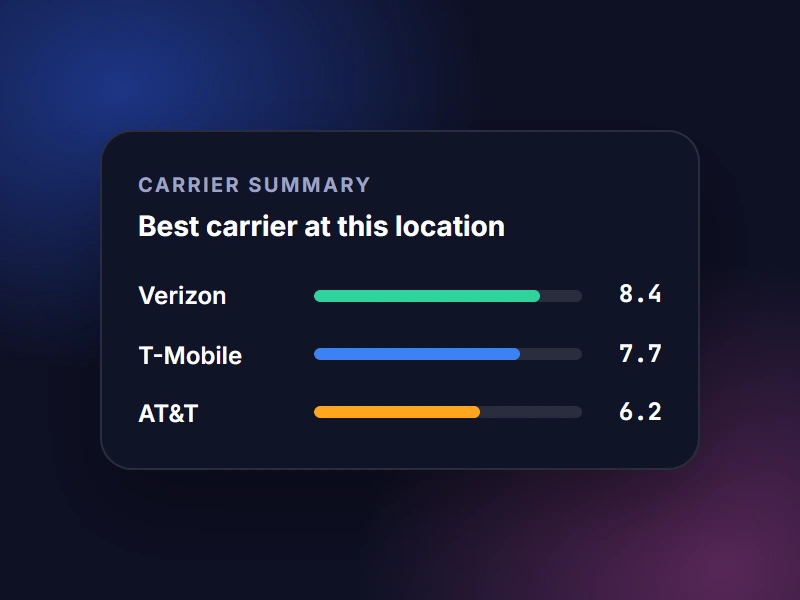
Carrier Summary
summaryCost: 1 unit per locationA simple 0 to 10 score that ranks how the carriers perform at each location.
- An overall score that ranks the carriers
- Performance, coverage and reliability scores
- Scored using FCC data and user speed tests
- Provides helpful sourcing and accuracy
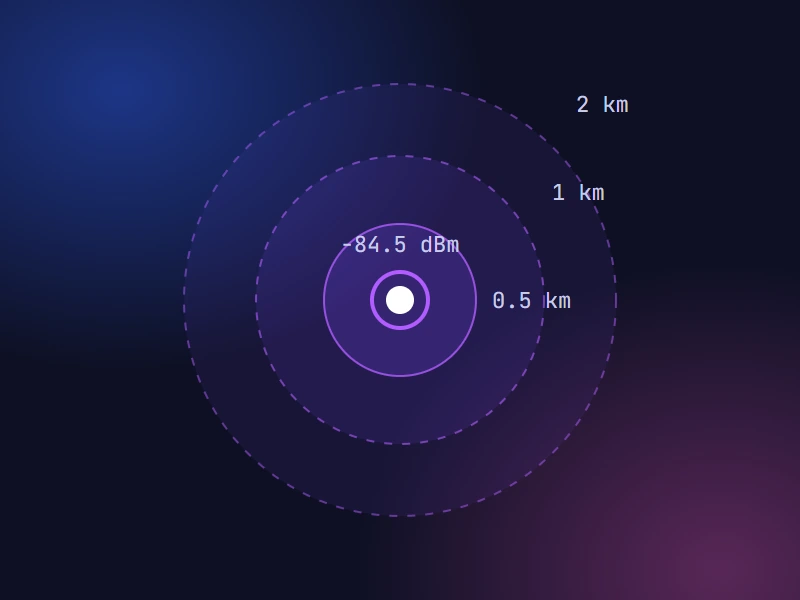
FCC Coverage and Signal Strength
fcc-coverageCost: 1 unit per locationModeled coverage from the FCC Broadband Data Collection, cleaned up and normalized so carriers are comparable. Returned per carrier and/or per technology.
- Signal strength in dBm at the exact point
- Signal strength within 0.5 km, 1 km and 2 km radii
- Area covered within 0.5 km, 1 km and 2 km radii
- Always up to date with the latest FCC data
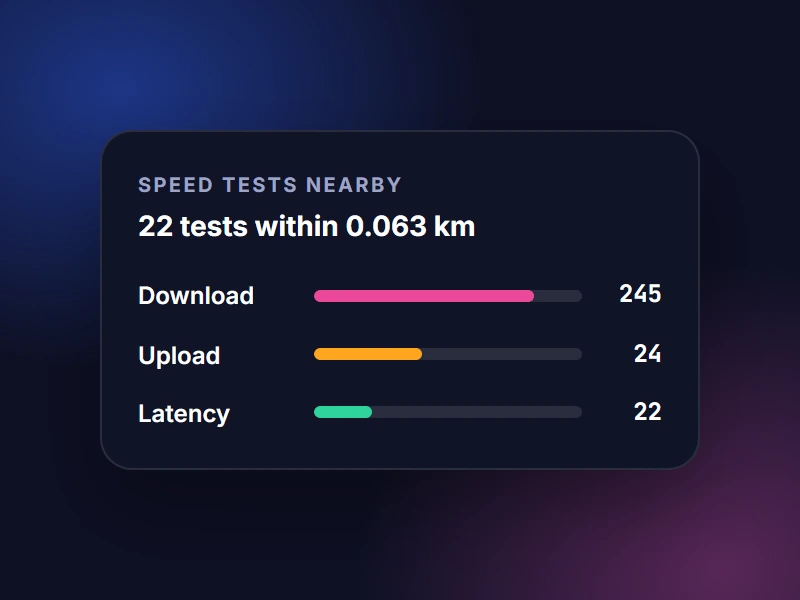
Crowdsourced Speed Tests
speed-testsCost: 2 units per locationReal-world latency, download and upload results from CoverageMap app users near each location, aggregated into summary statistics for quick analysis and comparison.
- Latency, download and upload speeds
- Sample counts and failed test counts
- Accuracy and distance fields for speed tests
- Rolled up at 0.5 km, 1 km and 2 km radii
What is included?
What the CoverageMap API includes on every plan.
Request and response
One POST request with up to 100 locations returns one JSON document with every carrier and technology you asked for.
POST https://enterprise.coveragemap.com/api/v1/coverage
Authorization: Bearer YOUR_API_KEY
Content-Type: application/json

{
  "datasets": ["fcc-coverage", "speed-tests", "summary"],
  "providers": ["VZW", "ATT"],
  "technologies": ["lte", "5g"],
  "locations": [
    { "id": "store-1", "latitude": 39.95, "longitude": -75.16 },
    { "id": "store-2", "address": "1600 Pennsylvania Ave NW, Washington, DC 20500" }
  ]
}{
"status": 200,
"messages": {},
"data": {
"country": "US",
"datasets": ["fcc-coverage", "speed-tests", "summary"],
"locations": [
{
"index": 0,
"id": "store-1",
"latitude": 39.95,
"longitude": -75.16,
"coverage": [
{
"provider": { "code": "VZW", "name": "Verizon Wireless" },
"technology": { "code": "lte", "name": "LTE" },
"fccCoverage": {
"signal": {
"signal": -84.5,
"halfKilometer": -85.1,
"oneKilometer": -86.3,
"twoKilometers": -88.9
},
"coverage": {
"halfKilometer": 1,
"oneKilometer": 0.985,
"twoKilometers": 0.912
}
},
"speedTest": {
"latency": {
"accuracy": "exact",
"min": 20, "med": 22, "avg": 22, "max": 24,
"count": 5, "failedCount": 0, "distance": 0.063
},
"downloadSpeed": {
"accuracy": "exact",
"min": 210, "med": 245, "avg": 240, "max": 290,
"count": 5, "failedCount": 0, "distance": 0.063
},
"uploadSpeed": {
"accuracy": "exact",
"min": 18, "med": 24, "avg": 23, "max": 31,
"count": 5, "failedCount": 0, "distance": 0.063
}
},
"summary": {
"overall": 7.4,
"performance": 6.8,
"coverage": 8.1,
"reliability": 7.0,
"isFullyCovered": true,
"source": "measured",
"accuracy": "exact"
}
},
{
"provider": { "code": "VZW", "name": "Verizon Wireless" },
"technology": { "code": "5g", "name": "5GNR" },
"fccCoverage": {
"signal": {
"signal": -97.2,
"halfKilometer": -98.4,
"oneKilometer": -99.1,
"twoKilometers": -101.6
},
"coverage": {
"halfKilometer": 0.94,
"oneKilometer": 0.87,
"twoKilometers": 0.71
}
},
"speedTest": null,
"summary": {
"overall": 6.1,
"performance": 5.4,
"coverage": 6.9,
"reliability": 5.8,
"isFullyCovered": false,
"source": "estimated",
"accuracy": null
}
}
]
}
]
}
}Every parameter and field is described in the coverage lookup reference.
Use cases
Choose your industry to see how teams like yours use the API.
Check before you ship or install
Teams that put the API right into their order, enrollment or install workflow.
Plan, monitor and invest
Teams that score many locations at once to find gaps and opportunities.
Other uses
A few more places where knowing the network ahead of time helps.
- EV charging and kiosksChoose the carrier for each charger, kiosk and vending machine before it's installed.
- Schools and librariesAssign lending hotspots to the carrier that works best at each student's home.
- TelehealthMake sure patients can hold a stable video visit before you book one.
- Fleet and logisticsPick the right carrier for every depot, yard and delivery zone.
- Events and venuesPlan payment, ticketing and backup connections for pop-up locations.
- InsuranceUnderstand connectivity for connected home and telematics programs.
Pricing
One plan with no tiers to monitor or switch between as usage grows. Every plan includes all three datasets, LTE and 5G, and AT&T, Verizon and T-Mobile. The free trial runs for one month; Pay-Per-Use renews monthly.
Free Trial
- Units included
- 500
- Usage pricing
- None, hard cap
- Locations per request
- 100
- Major carriers
- Included
- FCC coverage dataset
- Included
- Speed test dataset
- Included
- Summary scores dataset
- Included
- Address geocoding
- Included
- Regional carriers
- Not included
- SLA and enterprise support
- Not included
- Onboarding
- Not included
- License
- Evaluation only
Pay-Per-Use
- Units included
- 50
- Usage pricing
- Graduated per unit
- Locations per request
- 100
- Major carriers
- Included
- FCC coverage dataset
- Included
- Speed test dataset
- Included
- Summary scores dataset
- Included
- Address geocoding
- Included
- Regional carriers
- Not included
- SLA and enterprise support
- Not included
- Onboarding
- Not included
- License
- Commercial
Enterprise
- Units included
- Custom
- Usage pricing
- Volume discounts
- Locations per request
- 100
- Major carriers
- Included
- FCC coverage dataset
- Included
- Speed test dataset
- Included
- Summary scores dataset
- Included
- Address geocoding
- Included
- Regional carriers
- Included
- SLA and enterprise support
- Included
- Onboarding
- Included
- License
- Custom
| Feature | Free Trial | Recommended Pay-Per-Use | Enterprise |
|---|---|---|---|
| Monthly price | $0 | $49 | Custom |
| Units included | 500 | 50 | Custom |
| Usage pricing | None, hard cap | Graduated per unit | Volume discounts |
| Locations per request | 100 | 100 | 100 |
| Major carriers | Included | Included | Included |
| FCC coverage dataset | Included | Included | Included |
| Speed test dataset | Included | Included | Included |
| Summary scores dataset | Included | Included | Included |
| Address geocoding | Included | Included | Included |
| Regional carriers | Not included | Not included | Included |
| SLA and enterprise support | Not included | Not included | Included |
| Onboarding | Not included | Not included | Included |
| License | Evaluation only | Commercial | Custom |
| Sign up | Start 1 Month Trial | Get started | Contact us |
What is a unit?
- FCC coverage lookup1 unit per location
- Speed test lookup2 units per location
- Summary lookup1 unit per location
A unit is one location looked up in one dataset. Pay-Per-Use includes the first 50 units in the $49 monthly fee and bills each further unit at the rate of the tier it falls in, so there is one plan and no tiers to monitor or switch between as usage grows. Every location successfully returned without an error is billed, and speed tests only where speed test data is found.
Pay-Per-Use rates
| Units per month | Rate per unit |
|---|---|
| 0 to 50 | 50 units included |
| 51 to 250 | $0.50 |
| 251 to 1,000 | $0.20 |
| 1,001 to 10,000 | $0.10 |
| 10,001 and up | $0.05 |
Estimate your cost
Enter roughly how many coverage, speed test and summary lookups you make each month to see your units and estimated Pay-Per-Use cost.
Units per month1,750
Estimated monthly cost$374
Pay-Per-Use costs about $374 per month for 1,750 units: the $49 monthly fee covers the first 50 units and the remaining 1,700 units are billed at graduated rates.
Frequently asked questions
Answers to common questions about the API.
Who's this API for?
What does a request look like?
What is the summary dataset?
How are units counted?
What does the free trial include?
Which carriers and technologies are supported?
Which countries are supported?
Where does the data come from?
Can I cache or store responses?
How is Pay-Per-Use billed?
Get started
Sign up, create an API key and send your first batch request. The free trial does not require a credit card.